
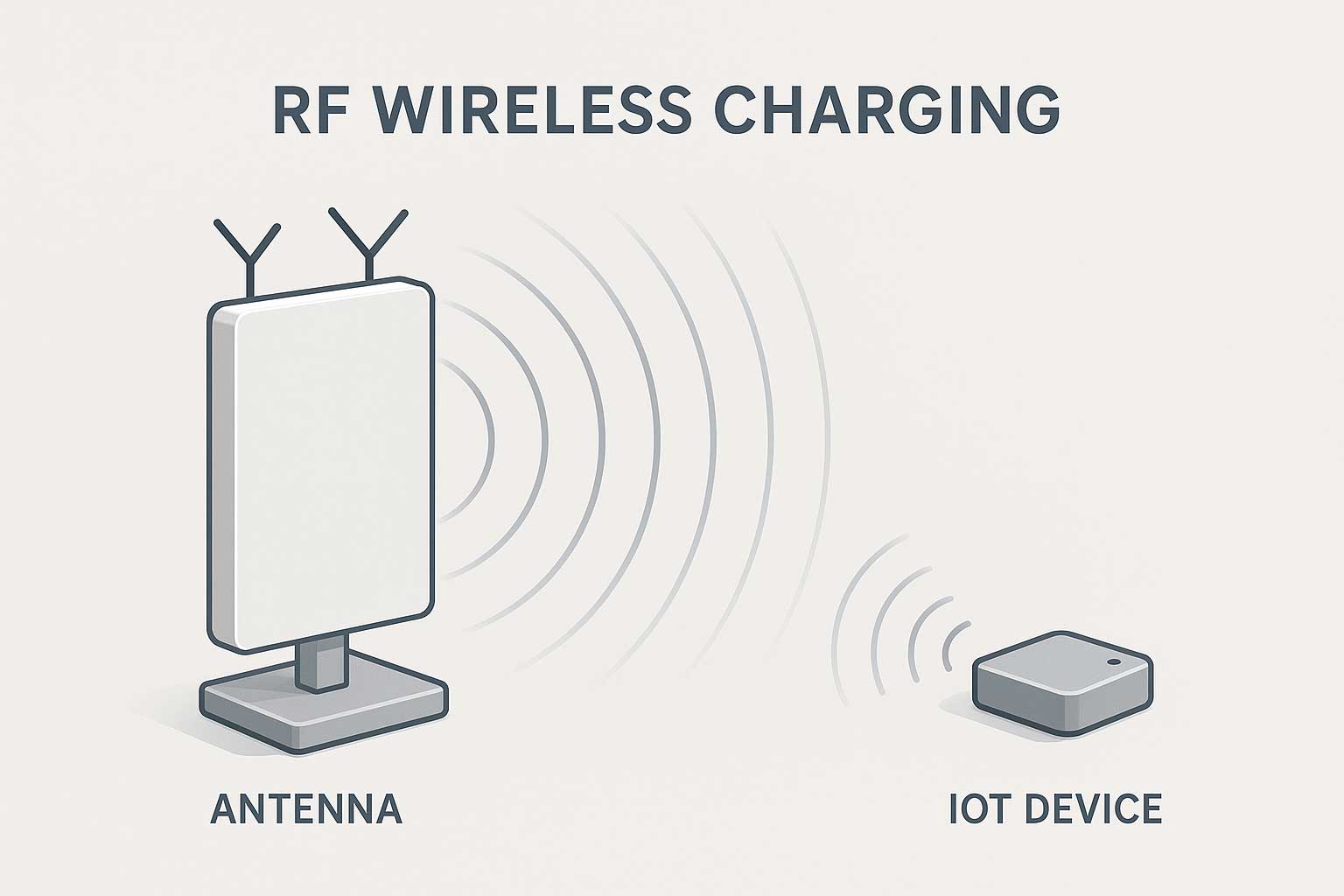
RF Wireless Charging: How Radio Waves Deliver Power Through the Air
Most people are familiar with radio waves as a way to send information — phone calls, Wi-Fi signals, Bluetooth connections, broadcast radio. But radio waves can carry something else too: energy. That idea is the foundation of RF wireless charging, a method where electricity moves through the air as radio-frequency power and small receivers convert it back into usable electricity.
RF charging is not designed to run appliances or recharge a laptop. Its strength lies in something far more subtle: delivering tiny amounts of power across meaningful distances, enough to keep sensors and low-power electronics alive without batteries or wires. For the growing world of connected devices, that’s a quiet but important breakthrough.
The Core Idea: Turning Electricity Into Electromagnetic Waves
RF wireless charging starts with a transmitter that converts electrical energy into radio waves at a specific frequency. These waves spread through the environment, much like Wi-Fi or Bluetooth, but at power levels chosen carefully for safe, regulated operation.
A receiving device picks up the signal with a small antenna, then uses a rectifier circuit to turn the alternating radio wave into direct electrical power. The process is the same idea behind a crystal radio set — just with modern hardware and far more efficiency.
The key steps look like this:
- A transmitter emits RF waves carrying small amounts of energy.
- The waves travel outward through air, walls or open space.
- A receiver antenna captures the signal and directs it to a rectifier.
- The rectifier turns the RF energy into DC power that can charge or maintain a device.
None of this requires special materials or exotic physics. It uses the same electromagnetic principles that power everyday communication systems.
How Much Power Can RF Charging Deliver?
RF charging is fundamentally low power. It’s not a way to charge a smartphone from across the room. The typical power range is in the milliwatt or microwatt scale — just enough to:
- run sensors
- extend battery life
- replace disposable batteries altogether
- power identification tags or location beacons
What RF charging loses in raw power, it gains in reach. The distance can be several metres, sometimes more, depending on the transmitter’s design and the regulatory limits in place.
The Real Advantage: No Touching, No Alignment
Magnetic charging pads require close physical proximity. Laser links need a clear line of sight. RF charging is different — it behaves more like a Wi-Fi signal, filling a space rather than aiming at a single point.
This makes it ideal for environments where devices move, hide behind surfaces or sit in hard-to-reach places. A sensor buried inside a wall or attached to industrial equipment can stay powered without anyone replacing batteries.
Where RF Wireless Charging Is Used Today
RF power is already finding a home in sectors that rely on scattered, low-power electronics:
- Home and industrial IoT — motion detectors, temperature sensors, small automation modules.
- Retail systems — electronic shelf labels and asset trackers.
- Healthcare — wearables and monitoring tags that need continuous operation.
- Logistics — beacons and inventory trackers that need battery-free operation.
- Smart buildings — maintenance-free sensors that measure humidity, air quality or occupancy.
In many cases, RF charging serves as a quiet foundation — it keeps systems running without anyone thinking about wiring or maintenance.
Common Questions About Safety
Radio waves have been studied for decades, and RF wireless power uses them at low, regulated levels. The power densities are similar to or lower than those already produced by Wi-Fi routers and Bluetooth devices.
The safety guidelines come from well-established electromagnetic exposure standards. As long as the transmitter stays within these limits — which modern systems enforce automatically — RF charging operates comfortably below thresholds associated with tissue heating or biological effects.
Limitations: What RF Charging Cannot Do
Despite its usefulness, RF power has limitations:
- It cannot charge high-power devices.
- It becomes inefficient at long distances unless power remains very low.
- It requires the receiving device to operate at modest energy levels.
These constraints are not flaws — they’re trade-offs that make the technology safe and practical for the right jobs.
The Future: Rooms That Maintain Their Own Devices
The long-term vision is a space where sensors, tags and tiny electronics no longer rely on batteries at all. A single RF transmitter — built into a ceiling panel or router — could power dozens of devices quietly in the background.
As buildings become smarter and more connected, this kind of “ambient power layer” may become as normal as ambient Wi-Fi is today.
The Bottom Line
RF wireless charging won’t power your home or recharge a drone, but it excels at something equally important: freeing small devices from batteries and cables. By turning radio waves into a steady trickle of electricity, it makes sensors and tags more reliable, more maintainable and far easier to deploy at scale.
In a world filled with billions of low-power devices, that quiet capability matters a lot more than raw wattage. RF power isn’t about doing everything — it’s about doing the right things with elegant simplicity.

Leave A Comment