
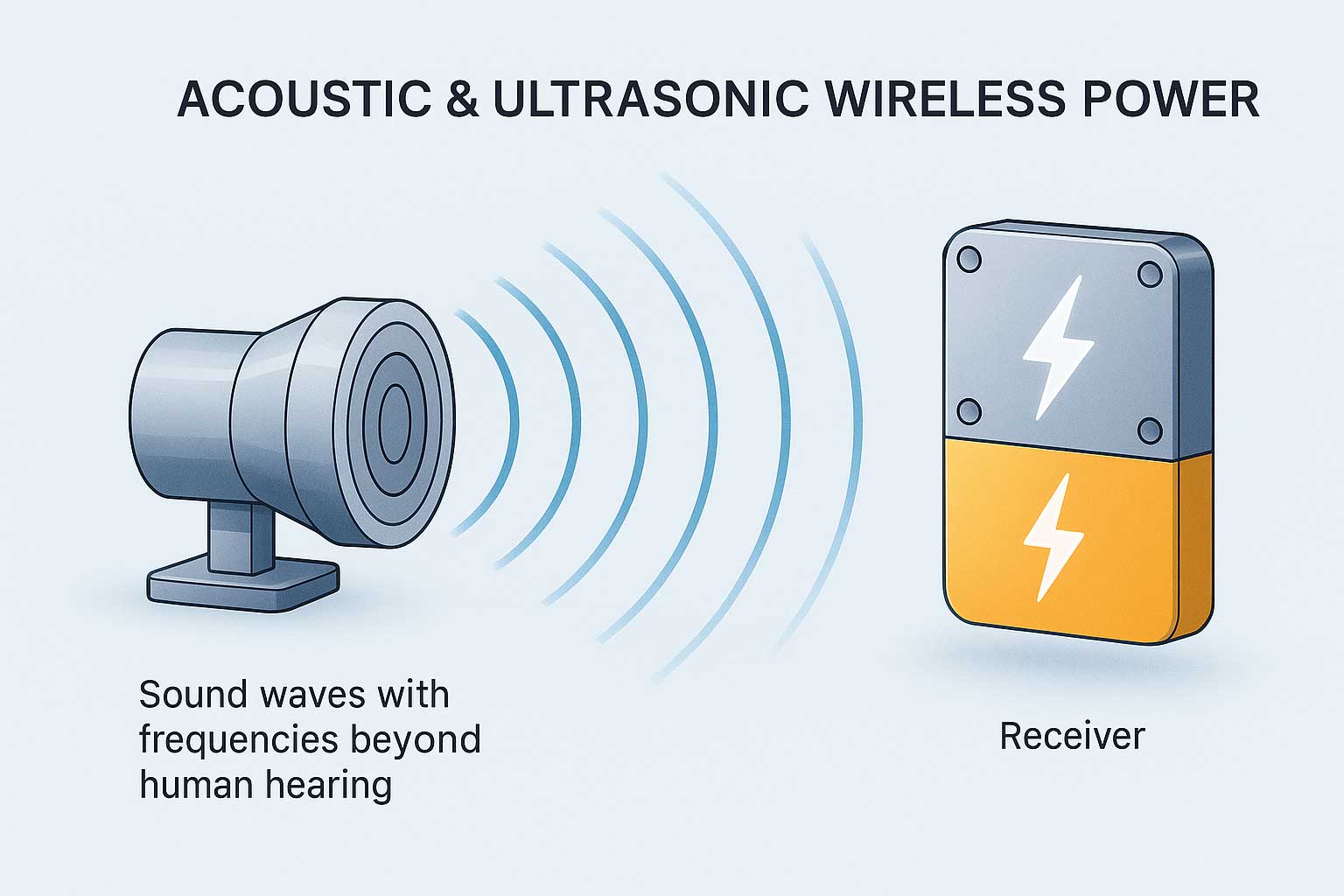
Acoustic & Ultrasonic Wireless Power: Can Sound Really Carry Electricity?
The idea of sending electricity through sound feels almost impossible at first glance. Sound is pressure, not light or magnetism, and we usually think of it as something that carries voices or vibrations — not power. Yet a growing field of research suggests that under the right conditions, acoustic waves can transport usable energy and deliver it to electronic devices.
This is not mainstream wireless power like magnetic charging pads or radio-frequency systems. Acoustic power transfer is still in its early stages, living mostly inside research labs and specialised engineering projects. But the science behind it is real, and the possibilities are intriguing enough to deserve attention.
The Basic Idea: Turning Sound Waves Into Electrical Energy
Sound is mechanical movement. When air, water or a solid surface vibrates, that vibration travels outward as a wave. If you can produce enough pressure in a controlled way, and if a receiving device is built to interact with those vibrations, you can convert that motion into electricity.
The key is a material called a piezoelectric transducer — a component that generates electrical charge when it is compressed or stretched. When ultrasonic waves hit the transducer, they make it vibrate rapidly, producing a small but usable current.
In simplified form, the process looks like this:
- A transmitter creates ultrasonic vibrations using a high-frequency acoustic driver.
- The vibrations travel through air or a solid surface toward a receiver.
- A piezoelectric receiver absorbs the vibrations and converts them into electrical energy.
- The electricity is regulated and stored inside a battery or capacitor.
Nothing shocking, nothing supernatural — just pressure waves and smart materials.
Why Ultrasonic, Not Audible Sound?
Human hearing tops out around 20 kilohertz. Ultrasonic systems operate far beyond that range — usually hundreds of kilohertz or higher. There are two reasons for this:
- Ultrasonic waves carry energy more efficiently at small wavelengths, which helps the receiver capture the vibrations.
- They avoid audible noise, making the system silent and less intrusive.
This also reduces interference with everyday sound and prevents the sensation of “hearing” the power transfer.
Where Acoustic Power Works Best
Acoustic wireless power is not designed for long distances or high wattage. It thrives in specialised environments where other forms of wireless power struggle.
Examples include:
- Underwater sensors — sound travels extremely well in water.
- Medical implants — ultrasound can safely penetrate tissue.
- Sealed equipment — no need for electrical contacts or holes.
- Industrial monitoring devices in enclosed or metallic environments.
In these cases, sound can go where electromagnetic waves weaken or become unreliable.
How Much Power Can It Deliver?
Today’s acoustic systems deliver modest power — enough to run a sensor, keep a small battery charged or maintain an implanted device. The goal is not to replace magnetic or laser-based systems, but to fill the gaps where other methods don’t work well.
Researchers are continually improving the efficiency of both transmitters and receivers, especially in medical applications. Even small increases in efficiency can make the technology far more practical.
Is It Safe?
Ultrasound is already used safely in medical imaging, industrial inspection and cleaning systems. Wireless power systems operate using similar frequencies, but with far lower intensity.
The main safety concerns involve:
- heat generation in tissue or materials
- mechanical stress on sensitive components
- interference with nearby equipment
For this reason, most acoustic power systems include tight control over intensity, frequency and duty cycle. When designed properly, the exposure levels remain below established safety limits.
Limitations of Acoustic Transfer
Acoustic systems have clear boundaries:
- limited distance — power drops quickly with range
- lower efficiency than magnetic or optical systems
- requires alignment for maximum performance
These challenges do not eliminate its usefulness — they simply define where it fits in the broader wireless power ecosystem.
The Future of Sound-Based Power
Ongoing research is focused on improving transducer materials, shaping ultrasonic beams more precisely and increasing efficiency over short to mid-range distances. Medical technology is likely to see the earliest real-world use, with implants powered through harmless ultrasound instead of internal batteries.
Acoustic wireless power will not light up buildings or run household devices. But in specialised environments — underwater, inside the human body, or within sealed industrial systems — it may become an essential tool.
The Bottom Line
Sound can’t replace electricity, but it can carry enough mechanical energy to power small devices when the receiving hardware is built to convert vibration into charge. Acoustic and ultrasonic wireless power is not a universal solution, but a targeted technology with unique strengths.
In the broader world of wireless energy, it fills a niche that no other method covers. Not every tool needs to be powerful — sometimes it just needs to work where everything else fails.

vrsbmt
vdjyulhjdqditpwkfzgkdfrwnmipfw