
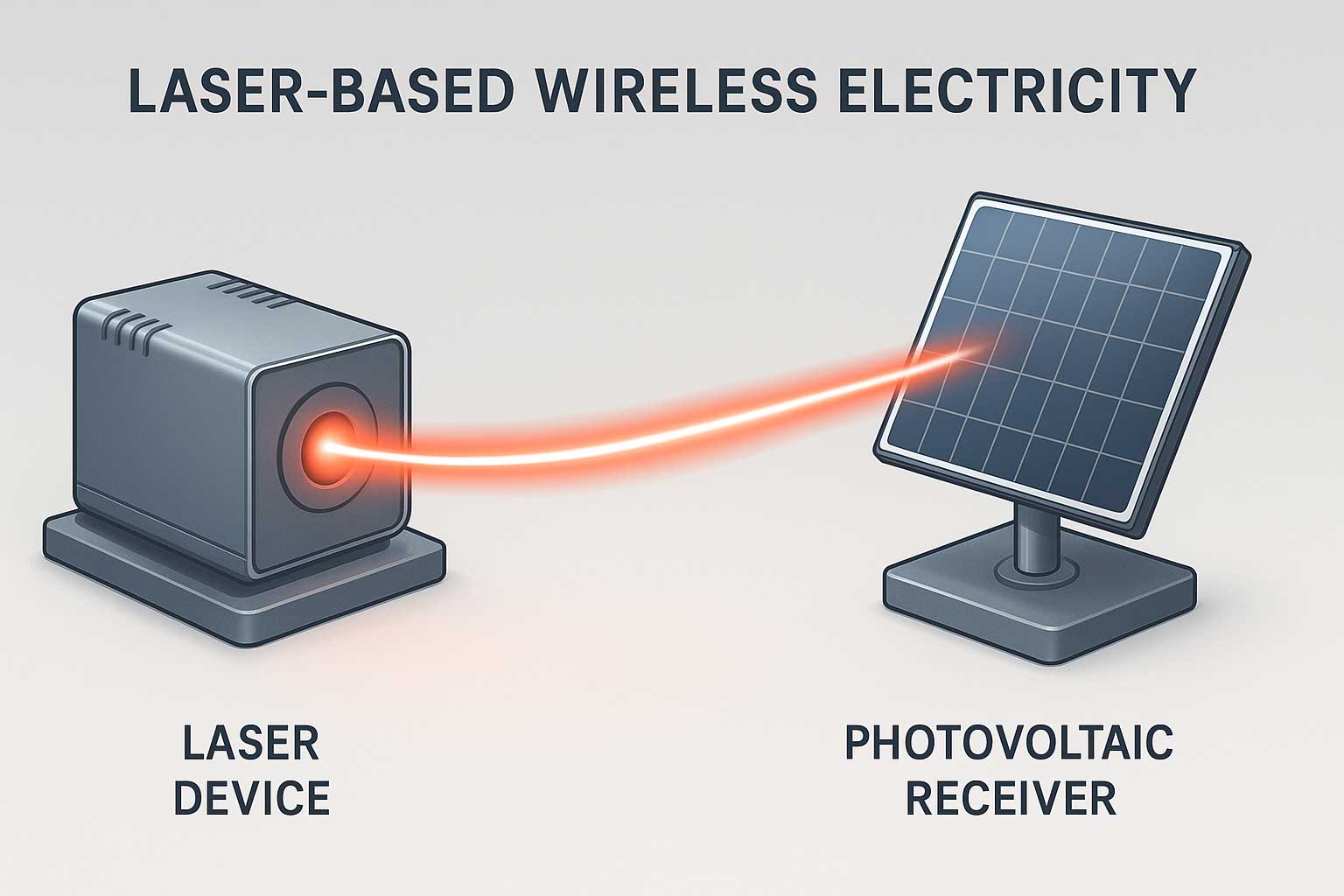
Laser-Based Wireless Power: How Energy Moves Through Light
Using light to deliver electricity sounds like something out of a science fiction film, yet it’s one of the most practical forms of wireless power being developed today. The idea is simple at the surface: convert electricity into a controlled beam of light, send that beam across open space and turn it back into electricity on the receiving end. Behind that simplicity sits careful engineering, strict safety design and a growing number of real-world uses.
Laser-based wireless power isn’t about replacing power lines or lighting up a whole room with energy. It’s a targeted, point-to-point link — more like an invisible optical cable than a broadcast signal. And in places where physical wiring is a problem, it can do things no copper wire ever could.
What It Means to Send Power Through Light
Every beam of light carries energy. Most of the time that energy is scattered in all directions, but lasers do something different: they focus that energy into a tight, coherent stream. That focus allows engineers to move power with accuracy and predictability.
The basic steps look like this:
- Electricity powers a laser diode and produces a controlled beam of light.
- The beam travels through the air, usually along a direct line of sight.
- A receiver captures the light using a photovoltaic (PV) panel designed for the laser’s wavelength.
- The PV receiver converts the light back into electricity, just like a solar cell — but far more precisely tuned.
Nothing exotic is required. The same physics that allows sunlight to power a calculator is behind this system, just with far greater control and efficiency.
Where Laser Power Makes Sense
Laser-based wireless power isn’t meant for charging phones on a nightstand. Its real strengths appear in environments where wires become a weakness — either because they’re unsafe, inconvenient or simply impossible to maintain.
- High-voltage or electrically noisy facilities where galvanic isolation is essential.
- Industrial machinery that moves, rotates or cannot be tethered.
- Remote sensors in hazardous or sealed environments.
- Defense and aerospace applications where reliability is more important than mass-market convenience.
In these settings, a laser link acts like a power cord made of light — perfectly insulated, immune to interference and completely isolated from electrical contact.
How Efficient Is It?
Efficiency varies based on distance, alignment and wavelength choice, but modern systems achieve surprisingly strong results. The limiting factor isn’t the laser itself; it’s the photovoltaic receiver. Solar cells tuned to specific wavelengths can convert light into electricity with far higher efficiency than traditional broad-spectrum solar panels.
Short-range, well-aligned setups can reach impressive efficiency levels. Longer distances introduce more losses, but the real advantage remains the isolation — not the raw percentage.
Safety: The Non-Negotiable Priority
No discussion of laser power is complete without talking about safety. A beam strong enough to carry useful power must be handled with precision. Because of this, modern systems include:
- Automatic shutoff when anything enters the beam path.
- Wavelength choices that reduce retinal risk.
- Beam shaping to distribute power safely at the receiver surface.
- Real-time monitoring to detect misalignment or obstruction.
With these safeguards in place, laser power becomes predictable and controllable — more like a tool than a hazard.
Why Use Lasers Instead of Radio Waves?
RF-based wireless power spreads out quickly, losing energy as it travels. A laser beam stays tight, holding its shape over long distances. This makes it ideal when:
- A direct path exists between transmitter and receiver
- You need more energy than RF can safely deliver
- Electrical contact must be completely avoided
It isn’t a replacement for broadcast-style wireless charging. It’s a precision tool for specific jobs where accuracy matters.
What the Future Might Look Like
Engineers are exploring portable receiver modules, compact diode arrays, and smarter beam-management systems that can redirect power dynamically. As the components get smaller and more efficient, laser links could supply everything from field sensors to autonomous robots without the maintenance headaches of connectors and cables.
The idea isn’t to flood a home with invisible beams. It’s to create clean, reliable, wire-free connections where ordinary wiring becomes the bottleneck.
The Bottom Line
Laser-based wireless power is not a replacement for the electrical grid — but it solves problems the grid was never built for. It offers precise, contact-free power delivery with total electrical isolation, making it valuable in places where wires cannot safely go.
Light has always carried energy. The difference now is that engineers can shape it, aim it and turn it back into electricity exactly where they need it. That’s the real power behind this technology: control, not spectacle.

Leave A Comment