
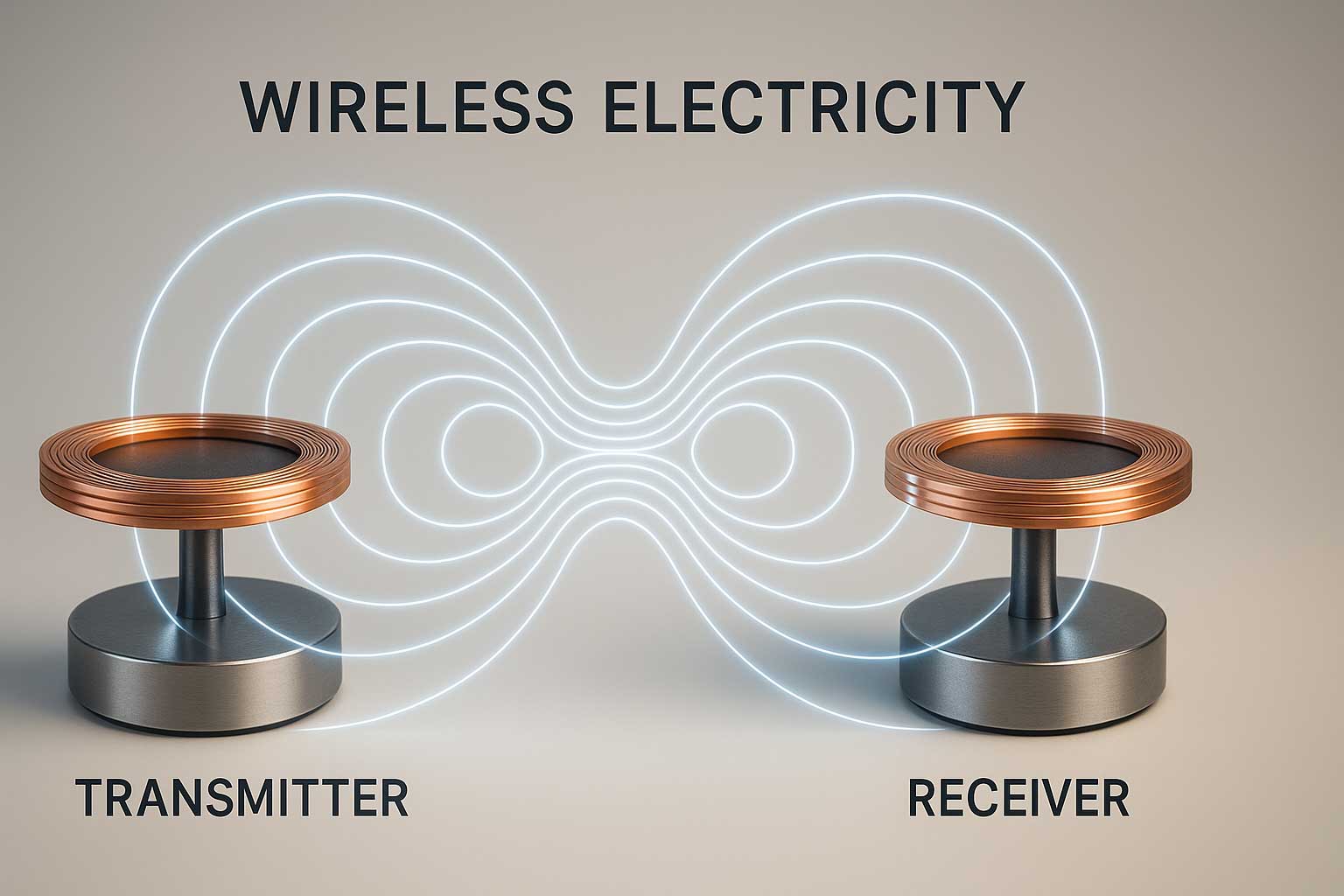
What Is Wireless Electricity? How Power Moves Without Wires
Wires have been the backbone of modern life for more than a century. They run through walls, under streets, across oceans. Yet quietly, in labs and prototype systems, electricity is starting to move without them. Power is beginning to travel through air, light, radio and even sound, instead of through copper.
This shift is not magic and it is not science fiction. It is the result of physics we already understand, applied in new, clever ways. Some of the technology is familiar, like the wireless charging pads used for phones. Other approaches are more experimental, like laser-delivered power or guided electrical paths through air. Taken together, they point to a future where many devices no longer depend on plugs and wall sockets.
Wireless electricity is still a developing field, but it is far enough along to deserve a clear explanation. That is what this page is for: a calm, grounded look at what wireless power really is, how it works, where it is already used and how far it can reasonably go.
Why People Want Power Without Wires
On the surface, wires do not seem like a problem. They are cheap, reliable and already installed almost everywhere. So why spend time and money trying to replace them, even partially?
The answer depends on where you look:
- Convenience. Cables break, tangle and get lost. Anyone who has swapped out phone chargers, laptop bricks or frayed power cords understands the appeal of cutting even a few of them out of daily life.
- Safety. In high-voltage or hazardous environments, running physical conductors can be risky. If power can be delivered without direct contact, the chance of shocks, arcs or mechanical damage can drop sharply.
- Maintenance and access. Some equipment is buried, sealed, rotating or simply hard to reach. Think of sensors in industrial tanks, devices in medical implants, or instruments in harsh climates. Wires can limit design choices or fail over time.
- Design freedom. As products shrink and become more mobile, designers look for ways to power and charge them without large ports or connectors. Wireless power opens up new form factors.
- Infrastructure costs. In some cases, especially where only small amounts of power are needed, it can be cheaper to broadcast power than to dig trenches, lay cables and maintain them.
None of this means that city-scale grids will be replaced any time soon. It does mean that there are many niches where wireless electricity already makes sense, and those niches are expanding.
The Basic Physics Behind Wireless Power
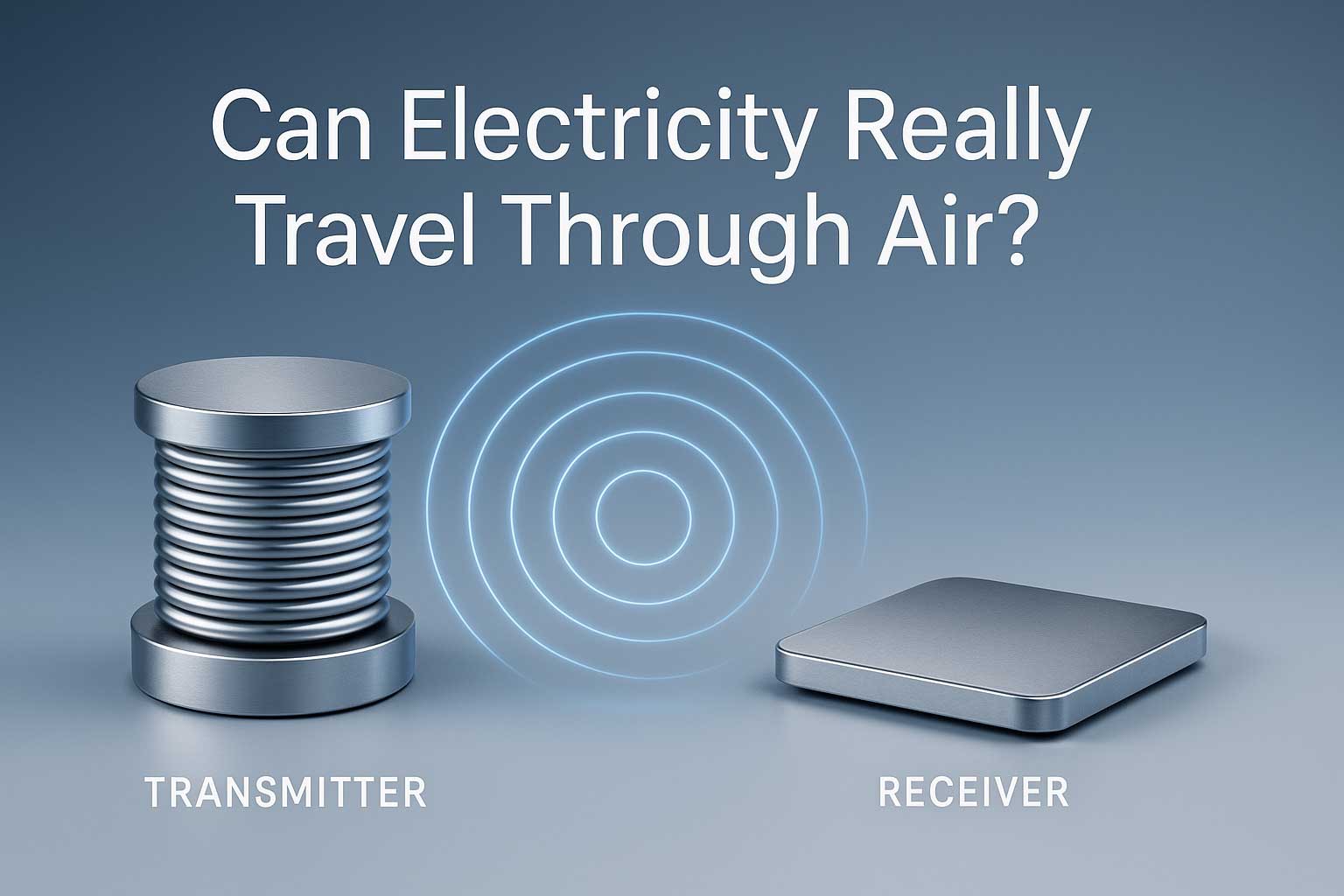
At its core, wireless electricity is simply the transfer of energy from one place to another without a solid conductor in between. The energy still has to travel through something, though. In practice, the “something” is usually a field or a wave: magnetic, electric, radio-frequency, optical or acoustic.
Most modern systems fall into a few broad families:
- Magnetic coupling. Energy moves between coils of wire using changing magnetic fields. This is the principle behind transformers, induction cooktops and many short-range wireless charging pads.
- Electromagnetic radiation. Energy is sent as radio waves, microwaves or light, then captured by antennas or photovoltaic surfaces and turned back into electricity.
- Electric fields or acoustic fields. In more experimental setups, power can follow guided electric paths or be carried using sound waves in air or solid materials.
The details differ, but the questions that engineers keep asking are always similar: How far can the power travel? How much is lost along the way? How precisely can it be directed? How safe is the field or beam for people, animals and nearby equipment?
Main Types of Wireless Electricity in Use Today
Even though the field is still evolving, a few approaches are already in practical use or serious development. Each one has its own strengths and limits.
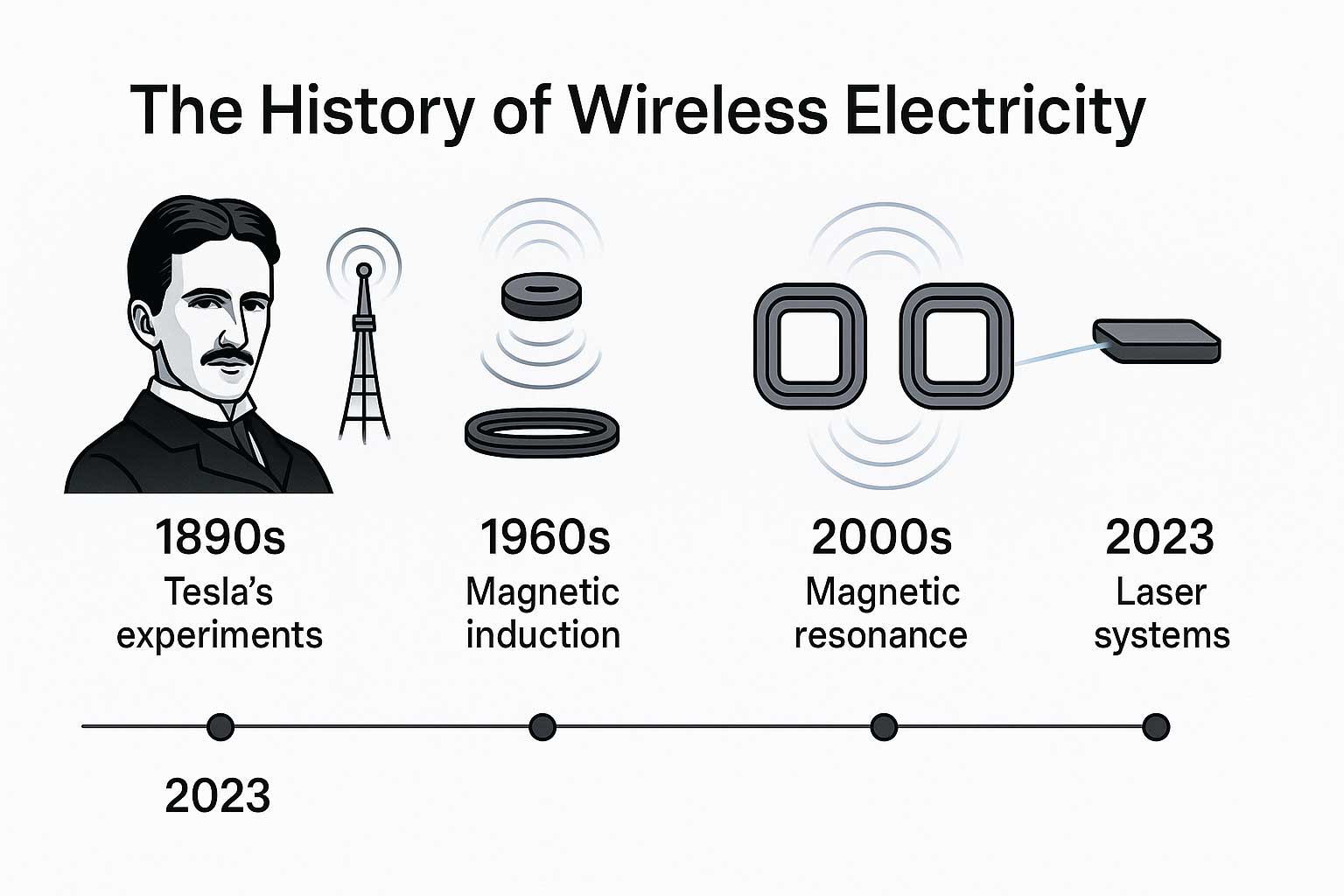
1. Inductive and Resonant Charging (Very Short Range)
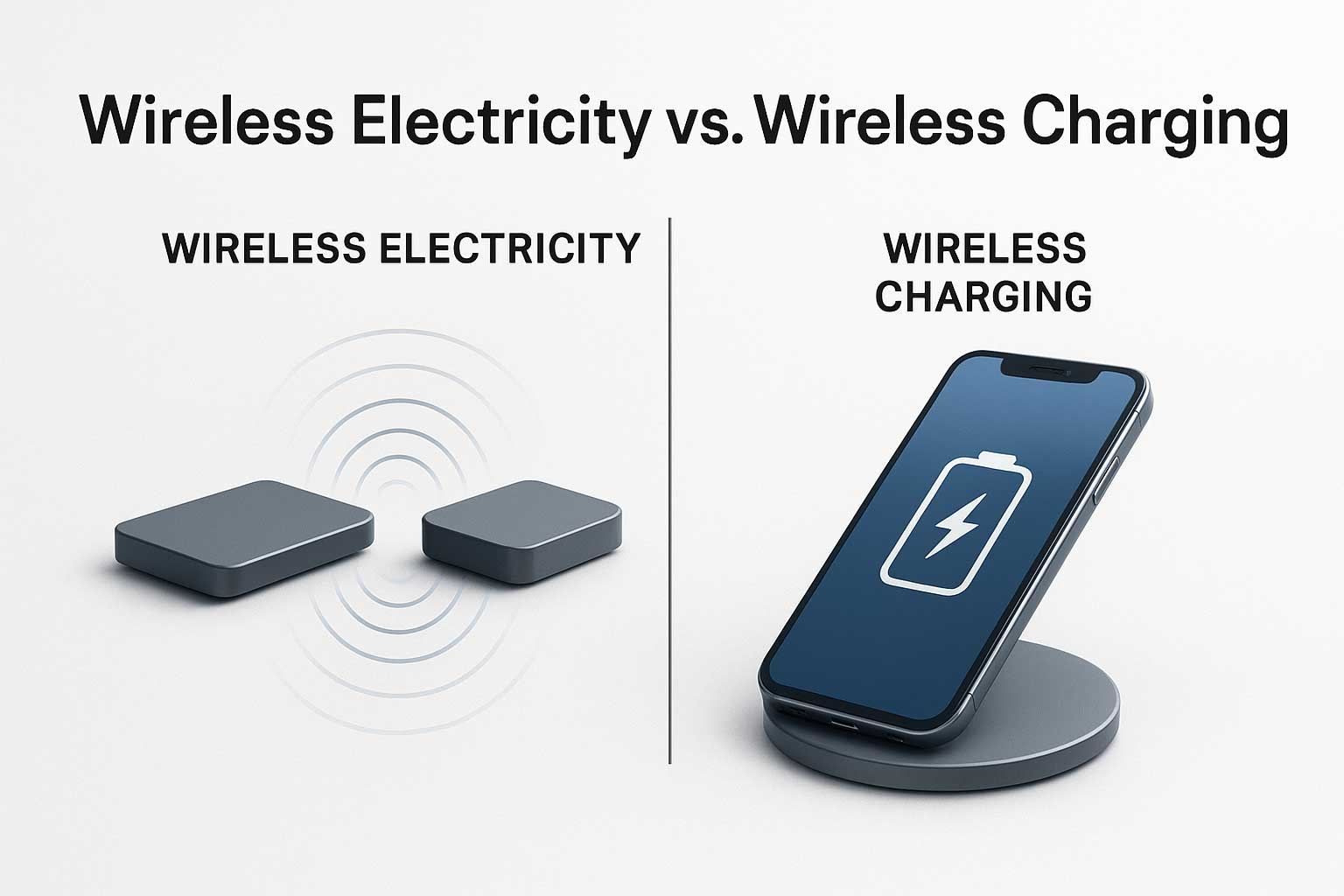
This is the most familiar form of wireless power. A charging pad generates a changing magnetic field using a coil. A second coil inside the device picks up that field and converts it back into electrical energy.
Typical uses include:
- Smartphone charging pads
- Electric toothbrushes and small gadgets
- Some industrial tools and robots that dock for charging
Range is very limited: the receiver usually needs to be touching the pad or extremely close to it. Efficiency, however, can be quite high, which is why this method is widely accepted.
2. Mid-Range Magnetic Systems
By tuning coils and circuits more carefully, engineers can extend the useful distance between transmitter and receiver. These “resonant” systems do not require perfect alignment and can sometimes charge multiple devices in a small area.
Examples of where this is being explored:
- Charging stations for electric vehicles parked over embedded pads
- Warehouse robots that top up as they pass certain points
- Furniture and desks with built-in fields for electronics
The trade-off is complexity. As distance increases, so do losses and interference, which means careful design is needed to keep the system efficient and safe.
3. Radio-Frequency (RF) Power for Low-Energy Devices
Radio waves already carry information through the air; with enough control, they can also carry useful amounts of power. RF energy can be broadcast in a room or directed in beams, then collected using antennas and rectifier circuits (often called rectennas).
Right now, this is most practical for small, low-power electronics such as:
- Environmental sensors
- Asset trackers and tags
- Certain kinds of IoT devices
Power levels are usually modest, partly because of safety limits and partly because efficiency drops as range grows. Still, replacing millions of button-cell batteries with harvested RF power would be a meaningful improvement for waste and maintenance.
4. Laser and “Power-by-Light” Systems
Another path uses light itself as the carrier. Electricity is used to drive a high-power laser or LED source. That light is then pointed at a receiver that converts it back to electrical energy, often using photovoltaic materials similar to those in solar panels.
This method can be very targeted. A beam can cross dangerous or electrically noisy areas without introducing a conductive path, which is valuable in places like:
- High-voltage facilities
- Certain industrial or military systems
- Remote or sealed equipment needing isolated power
The obvious requirement is line of sight. If the beam is blocked, power stops. Safety systems also have to ensure that the light does not damage eyes or sensitive surfaces.
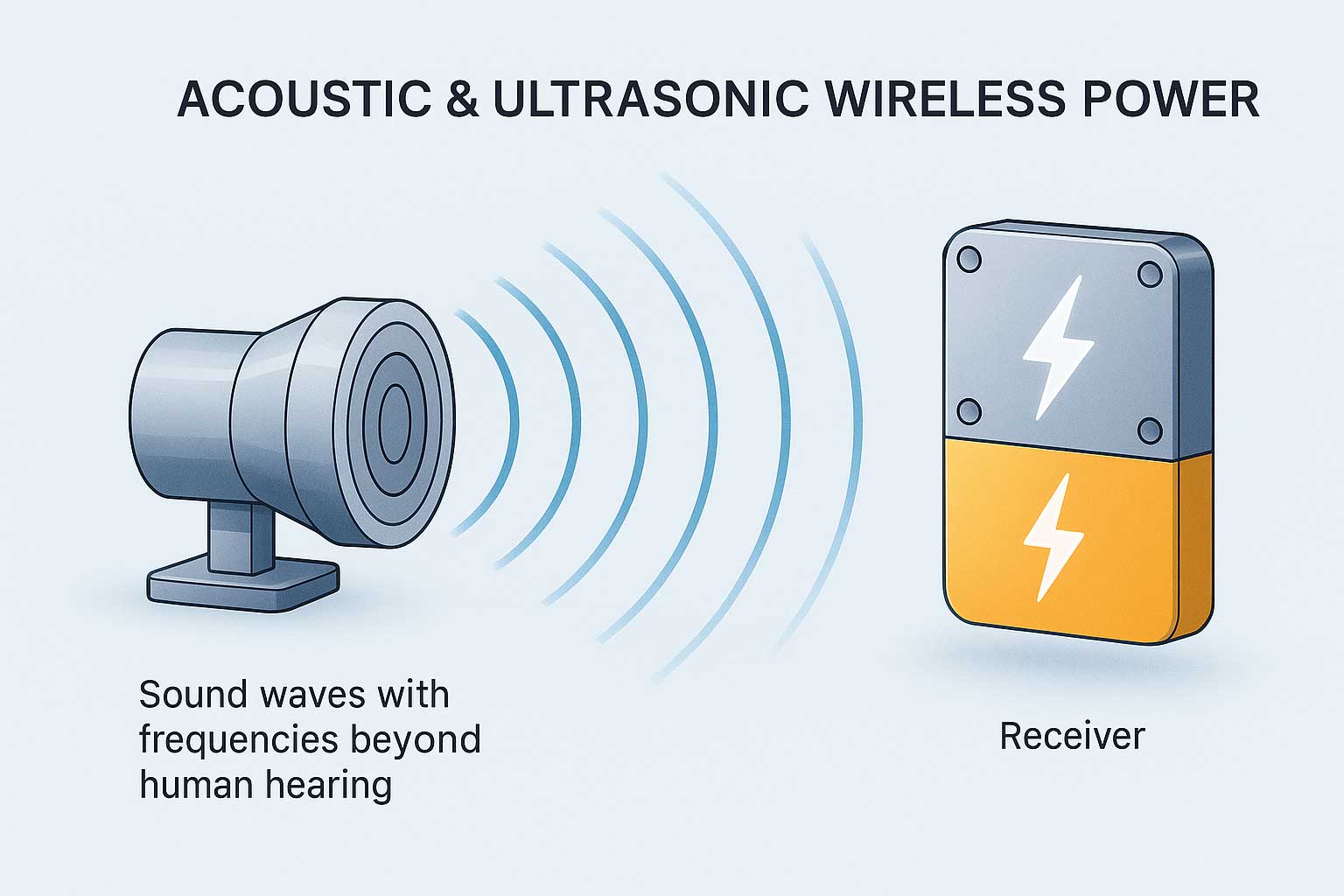
5. Experimental Ultrasonic and Acoustic Approaches
Some researchers are investigating ways to use sound waves, especially ultrasound, to shape the path electricity follows through air or to carry energy themselves. In one style of experiment, acoustic fields create a preferred path, guiding sparks or discharges along an invisible channel. In another, piezoelectric materials convert mechanical vibrations back into electrical power.
These methods are still largely in the lab stage. Their promise lies in the ability to steer power in flexible, dynamic ways or to reach places that are hard for conventional wiring.
What Wireless Electricity Can and Cannot Do Right Now
It is easy to imagine a future city with no visible power lines and devices that charge themselves from the air. Reality moves more slowly. To understand where things stand, it helps to separate what is common, what is emerging and what remains speculative.
What is already common
- Phone and gadget charging pads in homes, offices and public spaces
- Inductive power transfer in electric toothbrushes and similar sealed devices
- Short-range industrial charging docks for tools and robots
What is emerging
- Vehicle charging pads for electric cars and buses in specific test locations
- RF-powered sensor networks that operate without replaceable batteries
- Laser-based systems delivering power across high-voltage or hazardous areas
- Early demonstrations of guided electrical paths through air
What is still early or speculative
- Room-scale, high-power wireless electricity replacing wall outlets
- Neighborhoods or entire cities powered wirelessly through the air
- Long-distance, high-efficiency beams delivering bulk grid power
The direction of progress is clear, but so are the limits. Physics, regulation and economics all have a say in how far each method can scale.
Where You Are Likely to See Wireless Electricity First
Instead of thinking about a single “big” wireless grid, it is more realistic to look at many small, specific use cases. That is where the technology is most visible and most useful today.
Smart Devices and Consumer Electronics
Phones, earbuds, watches and similar devices are natural candidates. They are small, portable and regularly charged. As charging pads and furniture become more widespread, the idea of plugging in a cable for every top-up will feel increasingly old-fashioned.
Sensors and the Internet of Things
Factories, farms, buildings and cities rely on countless sensors to track temperature, pressure, motion, humidity and more. Swapping batteries in all of them is costly. Wireless electricity, especially RF-based systems, can supply enough power to keep these devices running with little or no manual intervention.
Industrial and Hazardous Environments
In places where sparks, corrosion or mechanical stress are a problem, removing physical contacts is a major advantage. Inductive, optical or acoustic power links can feed instruments inside sealed containers, rotating joints or high-voltage areas while keeping equipment and people safer.
Medical and Wearable Devices
Implants and body-worn electronics must balance size, comfort and reliability. Running wires through the skin is not practical. Batteries, meanwhile, have limited lifetimes. Wireless power allows certain implants and wearables to receive energy from outside the body, reducing the need for surgical replacement or bulky hardware.
Robotics, Drones and Automation
Mobile robots and drones are often limited by their batteries and the time they spend docked. Strategic wireless charging zones, embedded in floors or landing pads, let them top up during natural pauses in their work. Over time, this can make fleets more efficient and reduce manual handling.
Challenges and Open Questions
Every wireless electricity method comes with trade-offs. Understanding them is important for anyone trying to evaluate real products versus ambitious claims.
- Efficiency. Sending power through air or other media often wastes more energy than a simple copper wire. For some low-power uses, that may be acceptable; for high-power uses, it can be a serious barrier.
- Range. Power density usually falls off rapidly with distance. To keep things safe and practical, most systems stay in the short- to medium-range zone.
- Alignment and line of sight. Beams and focused fields may require precise positioning, which adds complexity to designs and installations.
- Interference. Radio and optical systems must coexist with communication networks, navigation signals and other sensitive equipment, which brings regulatory and engineering challenges.
- Safety. Any system that puts energy into the environment has to respect exposure limits for people, animals and electronics. Standards and testing frameworks are still evolving for some of the newer methods.
- Cost and business models. Even if a system works technically, it must be economically sensible. In many cases, wires remain cheaper for high-power delivery.
These constraints do not erase the value of wireless electricity. They simply shape where it makes the most sense and how fast it will spread.
The Road Ahead for Wireless Electricity
Step back for a moment and a pattern appears. Early, niche uses are already established. New, more capable systems are moving from labs into targeted applications. Grand visions of wire-free cities may stay on the horizon for a long time, but the number of cables in specific environments will keep shrinking.
The change will likely feel gradual rather than dramatic. A few more charging pads here, a beam-powered sensor network there, better inductive links in vehicles and tools, new experiments with sound or light shaping the paths of power. Day by day, electrical energy will rely a little less on visible metal and a little more on fields, waves and carefully managed beams.
That transition deserves careful, steady coverage. It touches safety, infrastructure, design, sustainability and everyday convenience. WirelessElectricity.org will continue to track that story as it develops, separating real progress from premature promises and focusing on the concrete systems that actually move power without wires.
Key Points at a Glance
- Wireless electricity is already common at very short ranges, especially in consumer charging pads and sealed devices.
- Mid-range, RF and laser-based systems are emerging for sensors, industrial setups and specialized equipment.
- Large-scale wireless grids are still far from practical, limited by efficiency, safety and cost.
- The most realistic growth will come from many specific use cases rather than one universal solution.
- The field sits at the intersection of physics, engineering, regulation and design, which makes clear, grounded explanations essential.

Leave A Comment